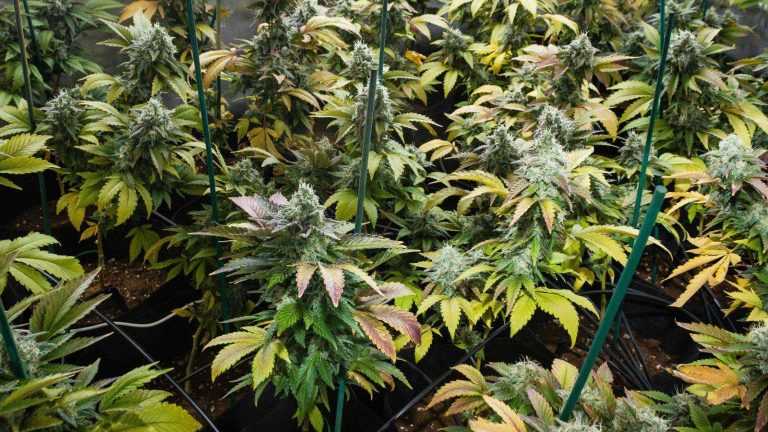
What Other Nutrients Are My Cannabis Plants Lacking?
Micronutrients also contribute to the health state of cannabis plants. Thus, it is also possible that your growth will suffer undersupply from these trace elements.
Magnesium
Primarily present in leaves, magnesium is a secondary nutrient that promotes leaf growth. A vital part of the chlorophyll molecule, Mg, directly affects your plant’s ability to absorb light.
A deficiency of magnesium can be seen first in the older leaves. As you have guessed, magnesium’s trait as a mobile nutrient explains this. Discoloration of leaf veins, i.e., having a light green or yellow coloring, is one tell-tale sign of Mg deficiency. Irregular rust-brown spots may also appear, and the stems of your cannabis growth might also become reddish.
This deficiency could become unmanageable if left untreated, costing you the lower leaves of your marijuana plant.
Experienced growers address Mg inadequacy by adding dolomitic limestone in their growing medium. Magnesium sulfate, garden lime, worm castings, and Epsom salts are good alternatives, too. Balancing the pH level should also work.
Iron
Considered as a micronutrient, iron helps your cannabis plant to have green foliage. The reason behind this is because Fe is a chief component as photosynthesis takes place. Additionally, the marijuana plant absorbs nitrogen adequately because of the iron nutrient.
An immobile nutrient leaves at the top of your plant will have yellow discoloration that signals iron deficiency. The color may even turn so bright it nearly becomes white. Although somewhat similar to magnesium deficiency, an iron-lacking plant has yellow pigmentation on its new leaves.
To treat this issue, flushing and adding nutrients should be considered. Spraying the affected area with iron chelate is also effective, albeit this solution is a bit temporary. pH stabilization of the soil is another cogent step. For this to happen, you must use soil additives, e.g., compost, elemental sulfur, and fertilizers.
Calcium
This micronutrient is present in all of the growth stages of cannabis plants. Although its percentage varies based on the growth stage, calcium has the following benefits to your growth:
1. Nutrient absorption
2. Cell membrane permeability
3. Pest and disease resistance
You can pinpoint if your plant is suffering from a calcium deficiency once the new growth has purple or yellow coloring. On average, your plant’s growth is even slow and stunted. The most common giveaway would be the large brown spots on the leaves.
Between outdoor and indoor growers, the latter group has a greater chance of experiencing calcium-wanting plants. The problem commonly lies in the scarcity of calcium in the hydroponics systems of indoor breeders. Practically speaking, this is addressed quickly by adding the nutrient to the water supply. Applying lime to the soil or substrate usually does the trick.
Sulfur
Although cannabis only needs a small amount of this nutrient, sulfur promotes leaf growth, resiliency against diseases and pests, enhancement of metabolism, robust root growth, and vital cellular processes.
Sulfur deficiency is considered relatively rare in the world of cannabis farming. Its most common indicator is the yellowing of the leaves, from top to bottom of the plant. When it comes to the leaves themselves, the discoloration begins at the back, moving to the tips and edges.
Correcting the pH level of your soil is the first step in treating this particular deficiency. The logic is to ensure that sulfur is not locked out. If you want to find out more about balancing the pH value, check out my post: “What pH value is best for weed plants”. Sulfur absorption is slow, which means a significant result of this treatment may take days.
Boron
This element is a vital immobile micronutrient that affects the cannabis plant at the cellular level. Boron plays a central role in building cellular walls. Moreover, in the process of photosynthesis, boron transports the needed sugars (carbohydrates).
Another rare case in growing marijuana, boron deficiency, becomes evident when the upper leaves’ growth becomes stunted and slow. Eventual twisting and wilting follow. The stems are also affected by becoming hollow and rough.
In addressing this inadequacy, growers would flush the growing medium and adjust the pH level until it reaches a desirable range. Providing enough moisture to your plants is a considerable course of action to solve plant issues regarding boron.